

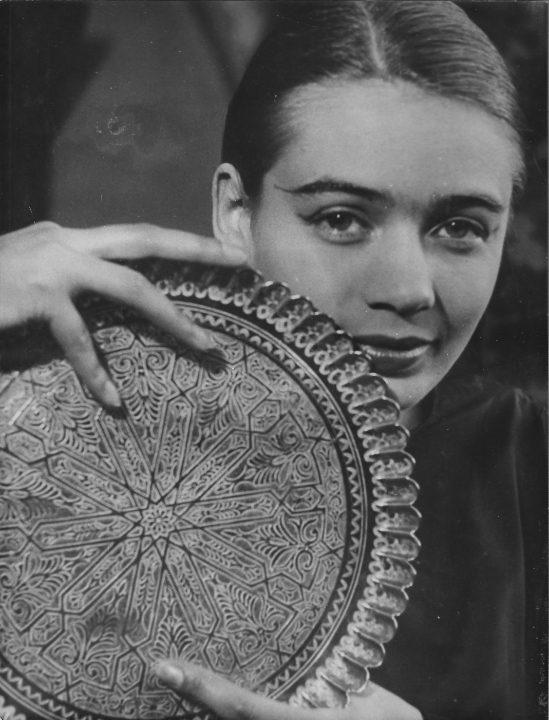
 In 2013 the BBC broadcast a programme in its popular TV series “Who Do You Think You Are?” In the series, celebrities are invited to delve into their family histories, guided by expert genealogists and subject specialists. The programme[1] featured the singer and actress Marianne Faithfull and threw a spotlight on Marianne’s late mother Eva, who had pursued a career as a dancer in Germany and Austria before the Second World War. Much new information came to light, thanks to the BBC’s researches, and more has emerged since.
“My mother had been another person entirely before the war,” Marianne Faithfull observed. “I always had a hard time imagining what she was like as a cool, urbane, young Weimar girl. It certainly didn’t carry over into her life with us. The war must have changed her drastically.”[2] In England Eva would tell her daughter alluring stories about her exotic life in pre-war Europe. Some of these were embroidered; some were probably fabricated. A few circulate uncontrollably on the Internet. This article is an attempt to present the known facts about her dance career, seasoned with a little cautious speculation.
Eva Hermine von Sacher-Masoch was born in Budapest on December 4, 1911, to Artur von Sacher-Masoch and his wife Flora. Her father, an Austrian nobleman, was a career army officer of Catholic faith, while her mother was Jewish – a detail that would have decisive importance in their later lives. She had an older brother, Alexander, born in 1901. Her great-uncle was Leopold von Sacher-Masoch, author of the infamous novel “Venus in Furs”, whose surname was co-opted in the 1880s by the sexologist Richard von Krafft-Ebing to create the term “masochism”.
Her earliest years were spent in various garrison towns in the east of the Austro-Hungarian Empire. From at least 1916 the family were in Karánsebes (in present-day Romania), the hometown of her maternal grandparents. We cannot be sure when Eva received her first dance education. A local teacher in Karánsebes, Zina Luca, taught “Harmonic Gymnastics,” and one of her students was her own daughter, Dia Luca – later to become a renowned Viennese ballet mistress – who was taught by her mother from the age of four. It is not impossible that Eva, who was the same age as Dia (and like Dia Luca, an officer’s daughter), also took lessons from Zina Luca.
In 1919, after the fall of the Habsburg monarchy, the Sacher-Masoch family was expelled from what was now the state of Romania. They relocated to Graz in Austria, hometown of Eva’s father.
It is likely that Eva pursued dance and gymnastics instruction in Graz alongside her regular studies. There were several opportunities for this at schools led by excellently trained teachers. Examples included Karin Schneider, a student of Rudolf von Laban and Mary Wigman from Odessa, who had taught in Graz since 1924, and Maria Rosanelli, an expert in rhythmic gymnastics based on the method of Émile Jaques-Dalcroze, who directed a school in Graz from 1925 onwards.
 We do know for sure, however, that from 1927 Eva was taught in Graz by Erika Hanka (then married to the lawyer Wolfgang Eiselsberg) at the school she ran jointly with Fritz Kaiserfeld. Erika Hanka – an exponent of “modern dance” – occupies a central position in Austrian dance history. She was, among other things, a member of the Jooss Ballets in England in the 1930s and ballet director at the Vienna State Opera from 1942 to 1958. Eva’s choice to train in “modern” rather than – the more familiar – “classical” dance points to a degree of self-awareness and an openness to contemporary trends.
On New Year’s Eve 1928, Eva took part in a “Lanner-Strauss evening” in Graz organised by Urania, a local institution devoted to adult education and cultural activities. This brought her first (known) press coverage. A reviewer noted that “the lecture series was enriched by dances, which were performed with consummate grace and outstanding choreographic confidence by Elsi Bendl and Eva Sacher-Masoch, charming young students of the Hanka-Eiselsberg School.”[3] There were repeat performances of this event in Radkersburg, a town in south-east Styria, on February 21 and 24, 1929. The latter drew more praise for the two performers: “Miss Sacher-Masoch, with her magnificent long Zöpfe [braids, plaits, pigtails]” was singled out as “a beautiful addition to the evening.”[4]
In an unpublished autobiographical note, her father Artur states that his family moved to Berlin in 1928. As Eva had continuing engagements in Graz, she may have followed a little later, but she was certainly established in Berlin by 1930 when we have our next sighting of her.
This was on November 2, 1930, at the Berlin Volksbühne as part of a “Working Group of Young Dancers”. In the first part of the programme, Eva performed in two group choreographies by Senta Hillert: “We Begin” and “Strange Game.” The second part of the programme consisted of the dance play “Halewyn”, based on a Flemish legend. The choreography for the latter was created by Lisa Ney, with music by Wolfgang Erben. Andrei Jerschik[5] played the title role and Eva appeared as one of six “noble ladies”.
 At this time Eva was studying for a diploma with the Palucca School. Founded by the noted German dancer Gret Palucca, this school originated in Dresden. A branch of the school, the Palucca School Berlin, opened in September 1928, so we may assume that Eva attended the Berlin school and only took the exams in Dresden. Palucca herself taught at the Berlin School whenever she came to Berlin. The director of the Berlin Palucca School was Senta Hillert (herself trained by Palucca and Mary Wigman), which would account for Eva’s appearance in Hillert’s choreographies at the Volksbühne.
In 1931, under the auspices of the Palucca School, Eva took an examination in dance education, submitting two papers focused on teaching dance to the general public – an area of professional concern to her for the rest of her life. “The objective of teaching lay people,” she wrote in the first paper, “should be to offer a group of dance-loving people the basic principles of dance and the joy of the harmonious and systematic development of the body.” A “hidden talent” for dance may be revealed, but more usually what occurs is “a greater understanding of body movement, the discipline of working together and the liberation of heart and soul.”[6]
 An undated photo preserved in the Deutsches Tanzarchiv in Cologne shows a smiling Eva with her close friend Hede Mehrmann (1909-1998) as members of the “Ballett Gerard”. From 1920 onwards, Ballett Gerard, named after its founder Hanns Gerard, was one of Germany’s leading variety ballets.[7] Ventures of this kind were among the main attractions of Berlin variety shows such as the “Wintergarten” and “Scala”. Since we don’t know exactly when Eva joined the Gerard company, it can only remain speculation whether she was a member during the ensemble’s guest performances at the Plaza, Berlin, in May 1931, in Vienna at the Ronacher Varieté (August/September 1931) or at the Orpheum in Graz (September 1931).
The partnership with Hede Mehrmann (a student of the famous Eugenia Eduardowa) would prove enduring. In newspaper reports the pair are described as “two young talents from the Reinhardt stages”.[8] This is cause for further speculation. The likeliest circumstance is that Eva and her friend were temporarily in the corps de ballet of the Grosses Schauspielhaus, Berlin, and appeared in one or both of Max Reinhardt’s lavish productions of Offenbach oper(ett)as, “The Tales of Hoffmann” and “La belle Hélène”. “The Tales of Hoffmann” was performed at the Grosses Schauspielhaus from November 27, 1931, to April 18, 1932, directed by Max Reinhardt, with choreography by Bronislava Nijinska and Anton Dolin. “La belle Hélène” (with musical arrangement by Erich Wolfgang Korngold) ran at the same venue from April 19 to May 31, 1932. Based on Reinhardt’s production at the Adelphi Theatre, London, it was choreographed by Léonide Massine. However, the detailed cast lists for the two works only name the dance soloists; the members of the corps de ballet, which was heavily involved in both productions, are not listed by name.
 By September 1932 the double act of Eva and Hede was sufficiently established for them to be booked together. Several contracts survive to show on what terms. In September they appeared at the Intimes Theater in Nuremberg performing two dances a night, in October at the Bonbonniere in Munich, where they performed three times a night. These bookings were as part of the Ping Pong collective, a satirical cabaret group founded by Kurt Egon Wolff, who acted as “emcee” or conferencier. Other significant figures in the ensemble included the composer Curt Bry and the singer Dora Gerson. The group had been invited to play in Scheveningen in Holland for the summer season 1932; they then returned to Berlin, which is evidently where they added the two young recruits. (After Hitler’s takeover in 1933, Wolff relocated to the Netherlands, where he briefly established a new ensemble before emigrating permanently to the USA.)
As to what was performed at these revues, newspapers describe “a show combining everything from utter nonsense to gentle, almost too gentle, satire”, with jazz on two pianos, poetry, “funny miniature dramas” and parody.[9] “The Ping-Pongs are more like actors and musicians than cabaret artists,” one reviewer noted. “They don’t improvise with silly jokes, hands in their pockets and shallow ideas.” Instead, they “turn a two-minute sketch into a polished little theatre piece.”[10] Parody was a recurrent element, with classic theatre and the Brecht-Weill “Threepenny Opera” in their sights. Eva and Hede were hailed as “two young talents who are visibly imbued with knowledge of their art – dance and parody”.[11] The only clue to the dancers’ repertoire is that they are credited with creating the “Bürgschaft-Parodie.”[12] The likely reference here is to the “The Pledge” by Friedrich Schiller (1797). Not so long ago, high school students had to learn this ballad by heart. With its themes of mutual trust, solidarity in times of need and unconditional loyalty, the poem may have acquired satirical edge in light of current events and found new meaning inside a political cabaret. (Alternatively, their dance might have referred to Kurt Weill’s opera “Die Bürgschaft”, which had premiered in Berlin in March 1932 but was swiftly driven from German stages by an overt political campaign – arguably because its plot bore unacceptable parallels with the rise of Nazism in Germany.[13])
Gunhild Oberzaucher-Schüller suggests how a poem might be translated into dance:
“The form – a duet – would allow for a dialogue, as seen in Schiller’s work. The ‘story’ could be presented episodically, faithfully following the original, or it could be suggested through short narratives. Crucial to the concept would be the style of movement, which would undoubtedly have to be exaggerated. The degree of exaggeration, the holistic use of the body, and the range of gestural movements would determine the choreography. This could range from gentle irony to biting mockery and the grotesque, depending on how the body is used. The whole effect could be underscored by the costume and striking makeup. The music used for the dance is also important, as it literally sets the tone.”
After this diversion into edgier material, the duo returned to the safer territory of the variety stage, with appearances at the Centralpalast in Munich (November 1932), the Drei Kronen, Augsburg (in December) and the Barberina, Berlin (January 1933).[14] According to their contracts, they performed duets and solo dances. The only indications of what they performed come from a series of studio photographs depicting them in costume.[15] Some show their “Cakewalk” dance. In this style, derived from American vaudeville tradition, they wear clownish outfits and parody a married couple, with Hede as husband and Eva as wife. In the louche atmosphere of late Weimar Berlin, the homoerotic undertones of having two women “married” to each other would not have gone unappreciated. Other photos depict them in elaborate eighteenth-century costumes. While not entirely identical, the costumes seem to “mirror” each other. The idea is to show how the two women complement each other, are projections of each other. When dancing, they probably moved in unison or mirrored each other’s movements, as often happens when a duo wears the same costume.
 Among Eva’s solo dances was apparently one drawing on her Jewish heritage. One photo shows her with long black braids in a costume and pose strongly suggestive of the character of Leah in S. An-sky’s play “The Dybbuk” (1914). The actress Hanna Rovina, an outstanding interpreter of this role, had toured internationally with the play. Her company, Habimah, performed at the Carl-Theater in Vienna in May/June 1926 and again in February/March 1928 at the Roland-Bühne, and it is possible that Eva saw Hanna Rovina in the role of Leah, or at least read about her, since Eva’s appearance in the photo is strikingly similar to Rovina’s. Reviews consistently emphasised Rovina’s excellent movement and gestures. Moreover, the productions of Jewish theatre groups like Habimah were inherently very movement-oriented and their guest performances caused a great stir and left a lasting impression. Taking Rovina as her role model, Eva might well have been inspired to develop a dance of her own, perhaps depicting the dramatic point where the dybbuk – a form of demon in Jewish lore – seizes control of Leah and forces her to dance.[16] She could not have been unaffected by the rising tide of antisemitism in Germany, and this dance, like her involvement with the Ping Pong collective, suggests a degree of political awareness motivating her choice of work.
In February 1933 Eva and Hede were engaged to play at the Alt-Bayern Kabarett in Berlin. Their repertoire here included a Portuguese “Fado” dance. The press were intrigued by the fact that, instead of castanets, they performed with small handbells.[17] This may not have been the only departure from tradition: photos showing the pair posing jokily in sombreros and knee-length breeches seem an uneasy fit with an ethnic musical genre normally characterised by a sense of resignation, fate and melancholy.
After Hitler was appointed Chancellor on 30 January 1933, the freedoms Eva and those like her had enjoyed in the Weimar years rapidly diminished. Her last-known engagement in Berlin was in June 1933 – appropriately, at the site of her first-known performance in the city, the Volksbühne. This had been a socially conscious, left-wing theatre, renowned for its political productions and connected to the Social Democratic Party. However, the new repertoire was politically unchallenging: “The Farmer as Millionaire”, a romantic fairytale play by the Austrian dramatist Ferdinand Raimund dating from 1826, in which Eva played “2nd Triton”.
Eva’s family left Berlin in 1933, moving first to Balatonszemes in Hungary before settling finally in Vienna in November 1934. One assumes that Eva accompanied her parents, although there is no trace of her engaging in dance activities in Vienna. We know that for up to two years (1936-7) she was living and working in Szolnok in Hungary, since there are residence permits in her name held in local archives. On March 10, 1937, at the municipal theatre in Szolnok, as part of a celebration for the “Stefaniebund”, she presented sixty of her dance pupils in “classical dance pieces choreographed specially for the occasion”.[18] She is described in a newspaper report as a “certified teacher of movement art.”[19] However, there is no record of a school in her name, suggesting that she taught dance at an existing local institution.
By 1938 Eva was back in Vienna and looking for a way out from a worsening situation. In August she placed an advertisement in the British press:
“Austrian lady, 26 years old, of best county family, qualified gymnastic teacher, with special experience of orthopaedic exercises for children, hospital experiences, wants SITUATION in Children’s Hospital, College or Private Family. Speaks fluently English, German, Hungarian. – Apply to Eva de Sacher-Masoch, 7 Museumstrasse, Vienna 7.”[20]
Evidently there were no replies – or none suitable – and she remained with her parents throughout the War. Although Eva’s mother had converted to Roman Catholicism when she married, Flora was still considered a Jew in the eyes of the Nazis. This meant, in their warped terminology, that her daughter Eva was a “Mischling [half-breed] of the first degree”. The whole family were in great danger, although Artur’s distinguished army record seems to have afforded them some protection, as did the house on Museumstrasse, which was owned by the Hungarian state and used by the “Collegium Hungaricum”, the cultural institute of the Hungarian embassy. There is evidence that Artur was involved in Resistance activity. In addition, her brother’s Socialist politics and outspoken journalism had drawn further attention to the family.
In April 1945, the Red Army reached the city. A drunken Russian soldier burst into the room where Eva and Flora were hiding. He raped Eva and was about to rape her mother, at which point – allegedly – Eva picked up a gun and shot him.[21] True liberation for Eva came several months later. When the British arrived to occupy part of the city, Eva fell in love with Major Robert Glynn Faithfull, a British Army intelligence officer, who called on the family to inform them that Eva’s brother Alexander, who had been fighting with the partisans in Yugoslavia and later working with the British Eighth Army, was still alive.
Summer 1945 brought another new opportunity. Eva took over the editorial responsibility for a revived magazine “Frau und Mutter” [Wife and Mother], which she continued to edit up to issue 7 in 1946. The summer 1945 issue contained a stirring editorial by Eva on the new freedoms opening up to women now released from the Nazi yoke, as well as articles by her father and brother and an interview with Grete Wiesenthal, one of the most influential exponents and teachers of “modern dance” in Europe at the time.
Eva and Glynn Faithfull married in June 1946 and moved to England, where their only child, Marianne, was born in December of that year. For an account of Eva’s later life, in which dance played a less significant role, it is best to consult the volumes of her daughter’s autobiography. Marianne’s writings provide many insights into Eva’s complex, forceful personality as it manifested in later life, albeit refracted through the lens of a troubled – but ultimately loving – mother-daughter relationship.
 Eva had difficulties in adjusting to her new life in England. The marriage, like many wartime marriages, did not last, and the couple separated in the early 1950s. Eva took various jobs, some menial, to support herself and her daughter. Notably, she worked at Bylands, a boarding school in Hampshire for what were then called “maladjusted” children, teaching dance, art and current affairs. This is a characteristic sidestep for those involved in the modern dance movement (to which she belongs.) After ending their dance careers, many practitioners would engage with the therapeutic aspects of dance, for example by working with those with learning difficulties or physical or mental disabilities. Her daughter sometimes watched her at work at Bylands and remembers “a type of free dance, very much like Isadora Duncan. The children danced in bare feet, made symbolic gestures, and acted out expressive scenes.”[22] Eva shared with her great compatriot the satirist Karl Kraus a lifelong antipathy to psychiatry and psychoanalysis. At Bylands she objected to the subjection of these already tormented children to psychological testing and interrogation about their childhoods and families. She felt the most important requirements in helping children were “action, empathy and love.”[23]
Other employment was at Chiltern Nursery Training College in Reading, where on Saturday mornings up to fifteen students took part in improvised, free-expression classes. A pupil recalls: “She would decide on a story and we had to act it out through dance. It was very enjoyable and she was encouraging us to think for ourselves.”[24] Performances were mounted locally, at least one of which – “The Princess and the Pea” – combined talents from Bylands and the Chiltern college and merited the attention of local media. The same pupil was involved in this production: ‘’Eva looked a bit like a gypsy and had a kind of flamboyance. In a way she was like a flower-power person before it came into fashion. I remember she had a bit of a fiery temper though!”[25]
She also worked for her daughter’s school, St Joseph’s Convent in Reading. In 1960 a mime ballet on adapted fairy tales proved a “refreshingly spontaneous performance” in the eyes of the local press. The children were “obviously trained to a high degree”, for which “great credit [was] due to Madame Eva Sacher-Masoch.”[26]This must be the programme in which her daughter played the lead in “The Snow Queen”. The teenage Marianne had her first period in mid-performance. “There was blood on my white costume, and even worse I had absolutely no idea what it was. My mother took no notice,” she recalled.[27]
 In the late 1960s Eva began studies “to become a proper teacher with references, credentials and better pay” but dropped out of college before completing her degree. This was at the time – 1967 – when her daughter was involved in a high-profile drugs scandal with The Rolling Stones. In Marianne’s words, “things began to fall apart for her and she started drinking heavily.”[28] Eva’s mental health appears to have been fragile throughout the post-war years but, this notwithstanding, her daughter records many happy memories of a vibrant personality rising above the challenges of a life split in half by the trauma of war.
Eva von Sacher-Masoch – or “Baroness Erisso”, as she liked rather inaccurately to style herself – died on May 22, 1991, and is buried in St. Mary the Virgin churchyard, Aldworth, Berkshire.
Additional material by Gunhild Oberzaucher-Schüller and Alfred Oberzaucher. My thanks to them, and also to Nicholas Dunbar, Karl Toepfer and Andrew Batt.
Footnotes:
[1] https://www.bbc.co.uk/programmes/b03bhsqv.
[2] Marianne Faithfull (with David Dalton), Memories, Dreams and Reflections. London: Harper, 2008, p. 55.
[3] Grazer Tagblatt, January 3, 1929.
[4] Grazer Tagblatt, February 28, 1929.
[5] An interesting fact is that in the 1950s and ‘60s Jerschik was ballet master of the Landestheater in Linz, the very theatre where, in 2012, Eva’s daughter Marianne would perform Weill’s “The Seven Deadly Sins”.
[6] Prüfungsarbeit 1931. I. Thema: “Laienunterricht und seine weiteren Ein- und Auswirkungen” [typescript].
[7] For a detailed account of Gerard’s career see https://www.jazzageclub.com/hanns-gerard/.
[8] München-Augsburger Abendzeitung, October 5, 1932.
[9] Münchener Post, October 5, 1932.
[10] Unidentified newspaper clipping, “Gastspiel von ‘Ping-Pong’ in der Bonbonniere”, October 5, 1932.
[11] München-Augsburger Abendzeitung, October 5, 1932.
[12] Unidentified newspaper clipping, “Ping Pongbonniere”, October 1932.
[13] Kim H. Nowalke, Kurt Weill in Europe. Michigan: UMI Research Press, 1979, p. 82.
[14] In the BBC programme, the historian Karl Toepfer described the opulently appointed Barberina as “the epitome of Weimar nightclub culture” and a prestigious booking for a young dancer.
[15] Preserved in the Hede Mehrmann collection, Deutsches Tanzarchiv, Cologne.
[16] Cf. this description of Rovina’s performance: “Leah, the bride. As if emerging from a glass coffin, in a white silk gown, her face dead and waxen, every expression drawn inward by the pain of her soul, as if numbed by life, yet through her eyes and mouth proclaiming the horrific possession – thus she stands, she lies, she dances, thus she writhes in convulsions as in a physical struggle with the demon, as if in a mad flight from the spell of overwhelming power. The moment – only a moment! – when, after the monotonous laments, a soft, high-pitched moan suddenly escapes her – a surprised cry, a breath, as if the dybbuk had just at that instant finally released its claws from the soft flesh of her heart – no, you will never forget this, not ever.” Bernhard Diebold, Habima: hebräisches Theater. Berlin-Wilmersdorf: Verlag Heinrich Keller, 1928, pp. 10-11.
[17] Unidentified newspaper clippings: “Alt-Bayern im Februar”, February 10, 1933; “Girls mit Glöckchenklang”, February 14, 1933.
[18] Pester Lloyd, March 11, 1937. The “Stefaniebund” appears on a list of Jewish organisations active at the time: https://spotlight.anumuseum.org.il/austria/vienna/organizations/list-of-organizations/.
[19] The term “movement art” (Hungarian: mozgásmüvészet) is the common Hungarian term for “modern dance”.
[20] Daily Telegraph, August 11, 1938.
[21] Faithfull, Memories, Dreams and Reflections, p. 57.
[22] Ibid., p. 58.
[23] Marianne Faithfull (with David Dalton), Faithfull. London: Michael Joseph, 1994, p. 8. Cf. “Psychoanalysis is that mental illness for which it believes itself to be the cure” (Karl Kraus, 1913.)
[24] Mark Hodkinson, Marianne Faithfull: As Years Go By. London: Omnibus, 2013, p. 15.
[25] Reading Standard, June 27, 1958; Hodkinson, p. 16.
[26] Reading Standard, November 25, 1960.
[27] Faithfull, Memories, Dreams and Reflections, p. 59.
[28] Faithfull, Faithfull, p. 124.